graffiti: art form or nuisance ?
I'm having a conflict of interest moment. I'm not sure how I feel about the removal of graffiti. I consider graffiti an art form, and I even wear a graffiti shirt to work. But here I am, writing up a proposal for a program that would employ youth to remove graffiti. I think employing youth is a good thing, and I think removing graffiti from private residences is a good thing, but when I see photos of kids online painting over huge beautiful murals, it's kind of heartbreaking.
San Francisco is known for its graffiti. Some is art, some is annoying, some is done by kids and some by professionals. What's worse is when corporations try to get all street and use graffiti as a form of advertising. There was a incident back in 2001 in which Gavin Newsom (he wasn't mayor yet) fought IBM and won more than $100,000 after the they admitted to misguidedly spray-painting ads for its Linux program all over San Francisco. In another case, The Public Works Department was responsible for cleaning graffiti stencils that read "The 4400 are coming." The phrase refers to a science fiction miniseries that debuted on the USA Network (part of NBC Universal). NBC claimed that they didn't know graffiti was illegal. Now that just pisses me off.
Somehow, despite the fact that San Francisco spends $2 million to remove it from public and private property, I am still drawn to it, often in awe. Everyone once ina while, you'll see a wall that's covered with something brilliant. Ron English is a well known graffiti artist. He hijacks outdoor billboards and creates his own art to make a statement of social or political commentary.

So most kids who tag are punks, yeah. Like "Tofu" who tags every single spot he can across the city. And they cost us money. But graffiti is a different story. I think graffiti is art, and some of those punks are going to be like Ron English someday. There's a connection between advertising and vandalism. The way I see it, all those companies with big ugly billboards that clutter the beautiful skyline are just as guilty of vandalism. Only they have money.
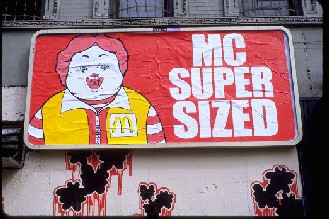
I guess I can justify creating this program becuase our kids will likely focus on erasing the work of fools who are tagging bus stops and people's houses. In the end, it comes down to having talent, having money, and knowing when to make your mark.
San Francisco is known for its graffiti. Some is art, some is annoying, some is done by kids and some by professionals. What's worse is when corporations try to get all street and use graffiti as a form of advertising. There was a incident back in 2001 in which Gavin Newsom (he wasn't mayor yet) fought IBM and won more than $100,000 after the they admitted to misguidedly spray-painting ads for its Linux program all over San Francisco. In another case, The Public Works Department was responsible for cleaning graffiti stencils that read "The 4400 are coming." The phrase refers to a science fiction miniseries that debuted on the USA Network (part of NBC Universal). NBC claimed that they didn't know graffiti was illegal. Now that just pisses me off.
Somehow, despite the fact that San Francisco spends $2 million to remove it from public and private property, I am still drawn to it, often in awe. Everyone once ina while, you'll see a wall that's covered with something brilliant. Ron English is a well known graffiti artist. He hijacks outdoor billboards and creates his own art to make a statement of social or political commentary.
So most kids who tag are punks, yeah. Like "Tofu" who tags every single spot he can across the city. And they cost us money. But graffiti is a different story. I think graffiti is art, and some of those punks are going to be like Ron English someday. There's a connection between advertising and vandalism. The way I see it, all those companies with big ugly billboards that clutter the beautiful skyline are just as guilty of vandalism. Only they have money.
I guess I can justify creating this program becuase our kids will likely focus on erasing the work of fools who are tagging bus stops and people's houses. In the end, it comes down to having talent, having money, and knowing when to make your mark.
posted by Freewendy @ 2:42 PM


1 Comments:
At 3:46 PM, Grandma said…
I think the correlation between graffiti on the NYC subway cars and crime is interesting. Once municipal workers started painting over every instance of graffiti in the early 90s, people stopped trashing the interior of the cars and crime on the subway (fare evasion, assault, theft) gradually decreased. Once something has been defaced illegally, it causes people to disrespect the property in other ways. It's a long and ungratifying-in-the-moment battle to decrease graffiti crimes, but it's possible. This program you are ambivalent about could be a start. Maybe cleaning up graffiti will teach your kids to see the consequences of tagging.
I do like the culture jamming type of graffiti, however. Leave the mom and pop business storefronts and the houses alone. Like anyone except the corporate money crunchers would mourn the defacement of another Starbucks or Hummer billboard.
Post a Comment
<< Home